Giving New Mexico farmers, producers, and local food retailers the tools to GROW.
Exploring the Benefits of Local Food in the FreshRx Produce Prescription Program: Portraits from New Mexico was a research project conducted in 2025 and led by the New Mexico Farmers’ Marketing Association (NMFMA). The research was commissioned in response to the growing recognition of the role that produce prescription (PPR) programs can play in helping address the current diet-related disease and health crisis in the United States (US). These types of programs, which are part of the broader “Food is Medicine” movement, [1] aim to improve health outcomes among nutrition insecure populations through healthcare providers giving patients prescriptions for fruits and vegetables. These initiatives also attempt to decrease healthcare utilization and costs, given that inadequate fruit and vegetable intake is linked to obesity, type 2 diabetes, and other diet-related diseases and health complications that add tremendous costs to healthcare and are among the leading causes of death in the US.
In New Mexico, PPRs and similar types of interventions are particularly important given that the state has the highest rate of SNAP participation in the country (21.5% of the population (Pew Research Center, 2025) ) coupled with high levels of obesity (34.6% ( Centers for Disease Control, 2021)), and food insecurity (16.6%, ( New Mexico Health and Human Services , 2022)) . Moreover, access to adequate healthy food is limited, as nearly 30% of the population live s in United States Department of Agriculture (USDA)-designated "food deserts” (USDA, 2017), which is the second highest percentage in the country (USDA, 2019). New Mexico is also a large, rural state with low population density: it’s the fifth largest state in the country by area (Wikipedia, 2026) and about 25% of its 2.1 million residents live in rural areas (America’s Health Rankings, 2026), meaning that many parts of the state are extremely sparsely populated. Additionally, New Mexico is racially and ethnically heterogeneous, with large Hispanic (49%), Native American (11%), and non-Hispanic White (36%) populations, and approximately 31% of people speak a language other than English at home – primarily Spanish or Diné (US Census, 2025 ) . Agriculture plays a very important role historically and economically, as many communities have been producing food for hundreds, and in some cases even thousands, of years (USDA, 2014). Total value of agricultural production in the state was $3.99 billion in 2023 (USDA, 2025), and total estimated economic impact in 2025 was $45 billion (Feeding the Economy, 2025).
In New Mexico and elsewhere, using locally grown food for PPRs is a way to support patient needs with culturally relevant , fresh produce while simultaneously supporting local farmers and strengthening local food systems and economies. Local community-based organizations (CBOs) like the NMFMA often manage these programs, serving as facilitators for and coordinating between healthcare providers and local food suppliers.
The NMFMA’s PPR programming dates back to 2012 when the organization initiated a small-scale pilot in conjunction with Wholesome Wave called “FVRx”, which ran successfully for about three years. Between 2014 and 2019, a modified version of the program called FreshRx moved forward on a limited scale with a single healthcare partner. Over the past several years, FreshRx has gradually expanded in terms of the number of healthcare partners, the number of people benefiting from the program, and geographic reach across New Mexico. To implement the program, the NMFMA partners with health clinics and other community-based partners across the state. As of 2023, the NMFMA was partnering with 23 clinic partners, reaching 1,550 families. The majority of the NMFMA’s clinic partners are Federally Qualified Health Centers, and the NMFMA has also worked with more than 16 Tribal partners. All produce provided through FreshRx is New Mexico grown, and the food incentive is either a Community Supported Agriculture (CSA)-style food bag/box or food vouchers that are redeemable at participating farmers’ markets. Additional resources on the FreshRx program can be found in Appendix E.
New Mexico is currently home to several Food is Medicine initiatives, including important work happening through a Medicaid Section 1115 Waiver. [2] The population being served through the Medicaid waiver is distinct from those typically served through FreshRx and other PPR programs – the waiver population has been deemed best served with medically tailored meals, which is a level of food is medicine intervention beyond that of weekly produce bags or farmers’ market vouchers. As a result, providers of PPRs in New Mexico have largely been unable to access Medicaid dollars and have continued to rely on USDA and other grant funding. Further, language in the 1115 waiver leaves little room for use of locally grown food. It is with this background in mind that NMFMA staff sought to undertake a project to dive deeper into the implications of local food procurement in Food is Medicine programming so that community partners, decision makers, healthcare providers and local food system stakeholders - such as those in the newly formed Food is Medicine Coalition in the state - can better understand the role of local food in these healthcare interventions.
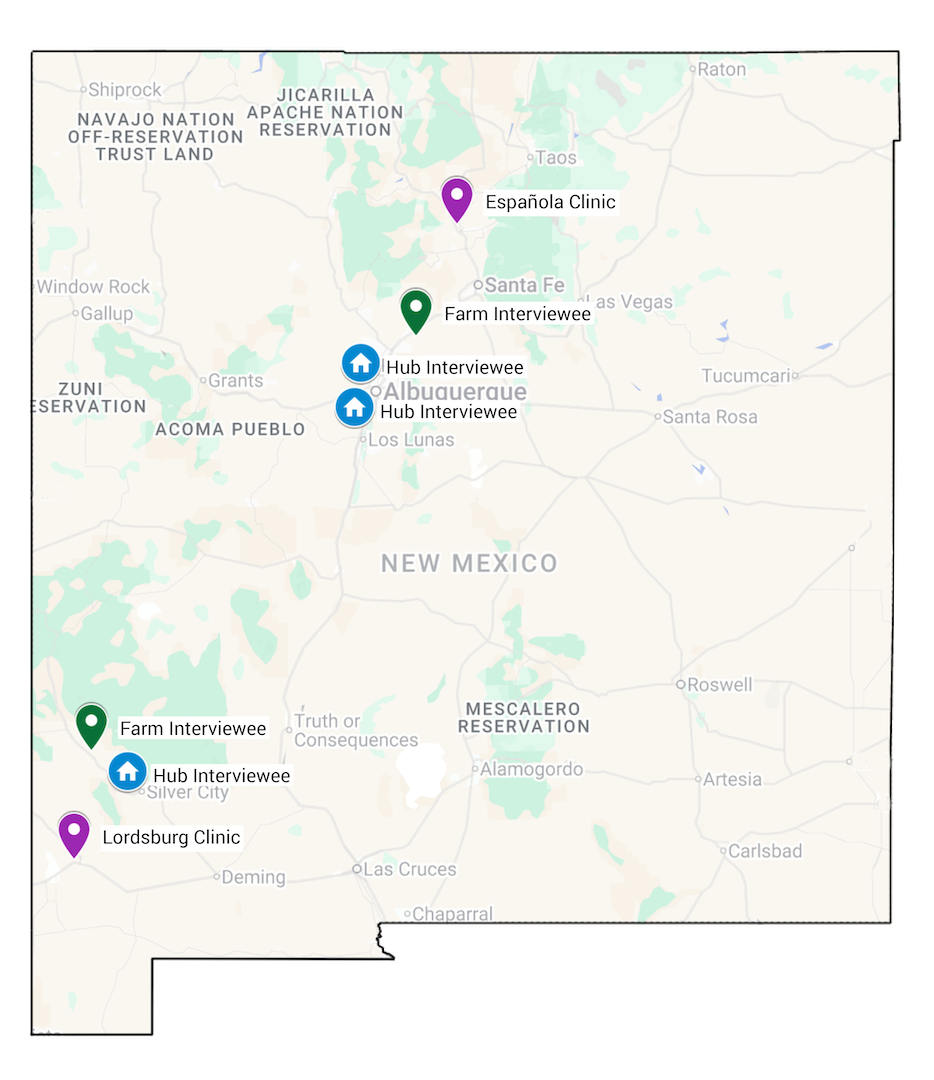
During 2025, the NMFMA implemented FreshRx in over 20 urban, rural, tribal, and frontier [3] communities across New Mexico. Patients received fresh produce for periods of 6-10 weeks, depending on the funding source. Nearly all produce was provided via food bags, and the vouchers that were provided were redeemed at eight farmers’ markets in seven different counties in the state. Produce bags typically included seasonal produce such as salad greens, kale, carrots, mushrooms, tomatoes, plums, melon and potatoes. Dried beans, dried red chile and chicos were also eligible items. The Exploring the Benefits research project focused on two of the FreshRx communities - Española and Lordsburg - both of which serve rural and frontier populations and are in different parts of the state (the northern and southwestern regions). The project map shows the state of New Mexico with locations of the two partner clinics in Española and Lordsburg as well as general locations for the five farms and food hubs that participated in interviews for this study. Note that all map locations are approximate - that is, none are exact locations.
Based on the context described above, the purposes of this research project were to deepen the understanding of:
i) utilizing locally sourced food in PPR programs, including considering how patients navigate the program and incorporate local produce into their diets as well as the producer experiences of supplying local food for PPR programs;
ii) inclusion of harder-to-reach underserved populations including frontier and rural communities experiencing high rates of food insecurity; and
iii) the roles local CBOs play in these programs.
To fulfill these purposes, the NMFMA research team employed multiple qualitative approaches that centered participant voices and experiences across the food supply chain . Supply chain mapping and semi-structured interviews were employed with six (6) individuals representing five (5) food suppliers (farmers and food hubs) involved in the Española and Lordsburg supply chains. In addition, Photovoice, [4] focus groups, and interviews were used with four (4) FreshRx recipients - two (2) in the Española area and two (2) in the Lordsburg area.
The findings presented here can inform future programming in New Mexico and, importantly, also educate broader audiences working on PPR efforts in other settings where local food sourcing can fill important needs not addressed by other sources in the supply chain, especially those in sparsely populated rural geographies with high rates of poverty, food insecurity, and nutrition-related conditions such as diabetes and obesity.
After this introduction, the rest of the report proceeds as follows: Section 2. Methods; Section 3. Española case study; Section 4. Lordsburg case study; Section 5. Broader Local Food Systems Contributions; and Section 6. Discussion and Recommendations. References, additional project-related resources, and all Photovoice photos are provided at the end of the report.
Footnotes: