Giving New Mexico farmers, producers, and local food retailers the tools to GROW.
 New Mexico is widely regarded as being home to the oldest continually inhabited communities and cultural landscapes in the United States, and many communities in the state have been producing food for thousands of years (USDA, 2014). Today, there are over 20,000 farms in New Mexico, more than 80% have annual sales of less than $20,000, a third are smaller than 10 acres, and 95% are family-owned and operated (USDA, 2022). The largest agricultural sectors by sales include livestock, dairy, alfalfa and hay, and food crops including chile peppers, pecans, and onions (USDA, 2025). Over the past 20+ years, many producers, advocates, non-profits, and others have been working to strengthen and promote local food systems in the state.
In recent years, the state has made significant investments in the local food system, which includes Governor Michelle Lujan Grisham’s Food Initiative - “ a comprehensive commitment to building a robust food system that measurably reduces hunger and improves equitable access to nutritious, culturally meaningful foods for all New Mexicans” (Coakley et al, 2024). Since its establishment, Food Initiative funding has increased from approximately $5 million in FY22 to $111 million in FY26 and includes investment in healthy universal school meals, a healthy food financing fund, Food is Medicine initiatives, and institutional local food procurement, among others (NM Department of Finance and Administration , 2026).
One result of these and other initiatives has been an expansion of market demand for local food. For example, funding for local food procurement through NM Grown, the state’s institutional purchasing program, has increased ten-fold from $525,000 in FY21 to $5.4 million in FY25 (Coakley et al, 2026). In addition, agricultural sales at the approximately 60 local direct-to-consumer outlets (farmers’ markets, CSAs, farm stands, and grocery stores) that are members of the NMFMA have grown from $8.5 million in 2022 to $14.85 million in 2025 (NMFMA, 2022; NMFMA, 2025). These and other increases in market demand have coincided with an expansion in the number and capacities of food hubs operating in the state, due in part to federal, state, and philanthropic local food investments focused on the middle of the supply chain. PPR programs such as FreshRx fit within this broader local food system movement, as illustrated through the interviews with the food suppliers for this research project that are presented in this section.
While there were a limited number of food supplier interviews, the small sample still shows an expansive reach and network when considering the number of farmers and consumers being impacted. Specifically, those interviewed included: two (2) farms that – when considering both of them combined – sell to several market channels including direct to consumer at farmers’ markets, to local food co-ops, to food hubs, and to the NMFMA’s FreshRx program; and three (3) food hubs that collectively source from 55+ farms and ranches in 11 counties in the central, northern, southern, and southwestern regions of the state. The hubs are also engaged in hub-to-hub coordination with one another (buying and selling from each other, collaborating on delivery and distribution, etc.) as well as with other hubs in New Mexico and the broader southwest region. The participants from the five (5) farms and hubs that were interviewed run 15-20 regular delivery routes to 16 counties and reach over 75 buyers and end distribution points, including institutions (schools, senior centers, early childcare providers), food banks, other Food is Medicine programs, farmers’ markets, local food co-ops, and other outlets, helping show the many connections and contributions FreshRx suppliers have to the broader local food system.
While producing a detailed map showing all of the source farm, hub, and end buyer/ distribution point connections is beyond the scope of this project, the basic schematic below helps to illustrate the reach of the three hubs that participated in the interviews.
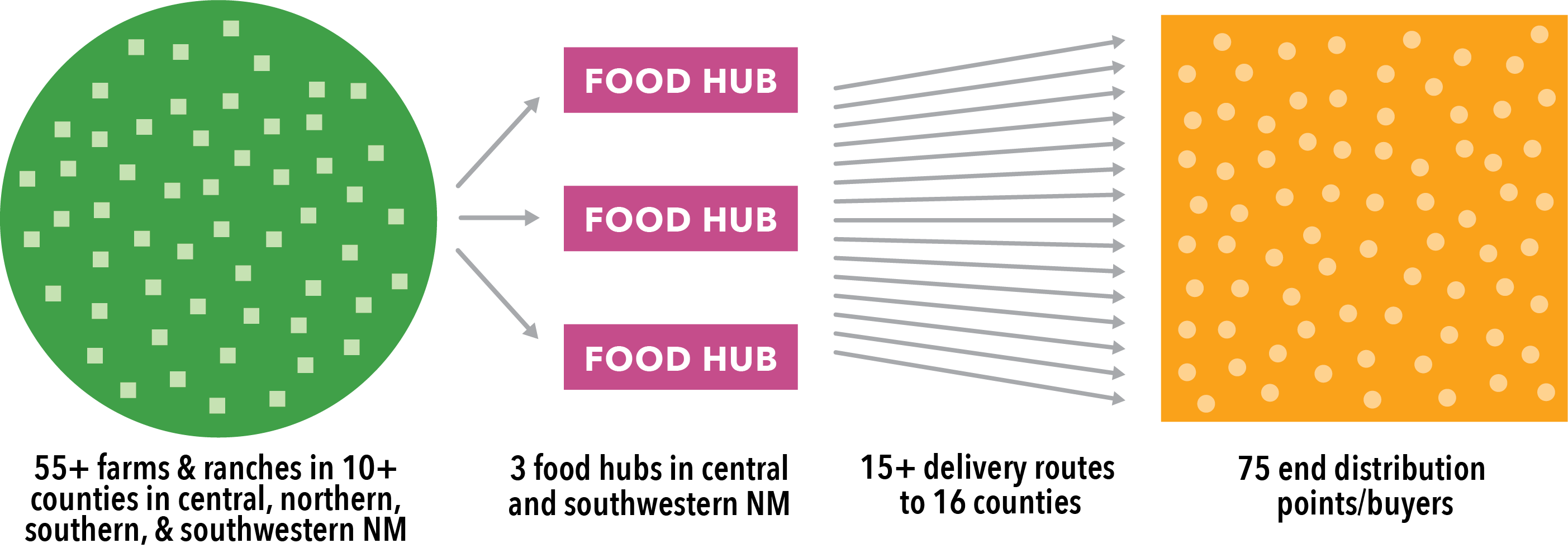
Considering the supply chain maps from the Española and Lordsburg case studies presented in Sections 3 and 4 along with this visual illustrates that FreshRx is just one piece in a much larger, coordinated local food system network that is reaching populations in urban, rural, frontier, and Tribal communities all around the state. This is the case even if the following are still true: the volumes of healthy, local food reaching these places are quite limited; there are many communities the network has not yet reached; and there are hundreds of other farmers and many additional hubs, processors, distributors and other food businesses involved in the production, sale, and distribution of local food in the state that are not included in this very limited supply chain snapshot. The supplier interviews thus help provide a deeper understanding of various characteristics and qualities of local food supply chain actors. In this section with quotes from the supplier interviews, F1 and F2 (Farmer Supplier 1 and Farmer Supplier 2) are farmers, and H1 (Food Hub Supplier 1) through H4 (Food Hub Supplier 4) are representatives from food hubs, which included operations and program managers and directors.
Several broader themes emerged through the interviews with the farmers and food hub representatives. These themes primarily revolved around the importance of collaboration, relationships, community, and resilience within local food systems work.
All of the food suppliers that were interviewed for this project emphasized the close alignment of FreshRx program goals of improving food access and serving underserved populations with the missions and values of their farms or food hubs. This was expressed mostly in terms of the program helping to create greater food access for Tribal and rural populations, reaching these communities with fresh, local food. Supplier interviews spoke of how FreshRx provides access to populations in extremely remote geographic locations in New Mexico and that many producers are also located in remote areas. This theme was illustrated by all interviewees:
“For us, when we start talking again about healthy food access, and food security, especially for Tribal entities like this, it's right in our wheelhouse of what we hope to do with our mission.”- H3
“We're able to keep the produce that we're growing locally, which is the higher quality produce as well, and put that in our communities first. Versus, you know, always being the last, the person at the end of the line to get something good. That's part of my mission, is to be able to provide that access of the highest quality produce that we can to our communities.” - F2
"It feels like kind of a community space where we're all contributing to this shared value of like creating greater access to fresh food in New Mexico.”- H1
“I think the biggest benefit to me is that other people have nutritious food. You know, I believe food is medicine, and I’m, you know, I want to share that with everyone, and that's kind of my life passion. I just want to grow food and feed people, but I want it to be good food.”- F1
“These are folks that maybe don't have access to these types of food, or, you know, are dealing with so many different pieces that it's hard for them to even just get, have access to a grocery store. That's, for me, that's the biggest benefit, because, you know, some of these folks are older, and, you know, as a Native person, our elders are the ones that carry the most knowledge.”- H4
“I think what's really special and unique about [redacted] food hub is our ability to reach rural and frontier communities that otherwise they're just left out of the equation for a lot of people.”- H2
“ It's crystal clear that, you know, these places that we're delivering to are truly in food deserts. And without FreshRx in some circumstances, you know, they might have to drive 30 miles or more to find fresh produce. So, when I think about the benefit of this program for the recipients, you know, there might be no greater benefit than that... Most importantly, you know, it really does, I think, highlight how difficult it is in those rural areas to find fresh produce, and how FreshRx really fills that gap.” - H3
Another theme that came up consistently in the supplier interviews was that of collaboration and relationships. For the FreshRx program, this was expressed in terms of collaboration among FreshRx partners and also farmer relationships with customers (for farmers selling at farmers’ markets), along with the value created from those partnerships for both the benefits of the program as well as for broader more system-wide benefit.
“I do think we've made some lifelong customers, you know, because they used the FreshRx initially, and they enjoyed the market and the food, hopefully, that they were return customers. I'm sure they're still coming, I'm sure they're still visiting.” - F1
“A huge benefit for [redacted] has been, you know, just establishing those relationships with other organizations that are a part of this... So I think it's just the relationships that we've been able to create or strengthen through the program is, I think, the greatest benefit for [redacted] as an organization or an entity.” - H3
Hub representatives also discussed their work in terms of building relationships and partnerships with the farmers and ranchers they source from:
“And so really, being able to have like these one on one conversations (with farmers) where we're like navigating all of the things like talking through all of their needs, how we can kind of make the partnership work and feel supportive for them.” - H1
In addition, the hubs spoke about hub-hub coordination:
“We also work a lot with the food hubs. So... [hub] and us, work closely together. They'll buy things from us. We buy things from them, as well as we recently partnered with [another hub]... (They’re) buying a lot from us. We're then able to deliver to them. Then they are able to then use that too, and we sell to our food hub partners at a reduced markup, just to help make sure the price of the you know, the final product, is very reasonable.” - H2
The farmers and hubs spoke about how FreshRx, other Food is Medicine programs, institutional food procurement, farmers’ markets, and local grocery stores are providing opportunities especially for smaller-scale producers to sell more of their product, thereby creating market access and market stability. This includes farmers’ markets in very small, rural communities, farmers’ markets and local grocery stores in larger towns and urban areas, food hubs, and institutions.
“ I know I'm reaching different, like, different customers and different areas. You know, the food hub takes it out of Silver City most of the time. And, so, and then like, Gila is my town, so I really like to provide a lot there, and then Silver City, they're the original (farmers’) market. So, I want to keep supporting them, too. Plus, well, just keeping all of them equally going, so, is good business practice.” - F1
Hubs in particular are helping provide access to markets that many small-scale producers otherwise would not be able to access, as hubs provide a wide variety of services to the producers they partner with. Services include 1-on-1 technical assistance to help farmers meet food safety and other buyer requirements, business and production planning, marketing, and more. Increased market access is primarily being done through hub sales to programs such as FreshRx, other Food is Medicine programs, as well as institutional procurement.
“ We can also source from farmers that can't typically sell to wholesale buyers because they don't have enough, like enough products. So we can kind of like Tetris people together to meet our numbers.” - H1
“We... help close the gap for these small farmers to be able to enter into markets that they otherwise would not have.” - H2
“ (Our hub is) Introducing another sales outlet that they may be able to tap into if they want to, you know, institutional.” - H4
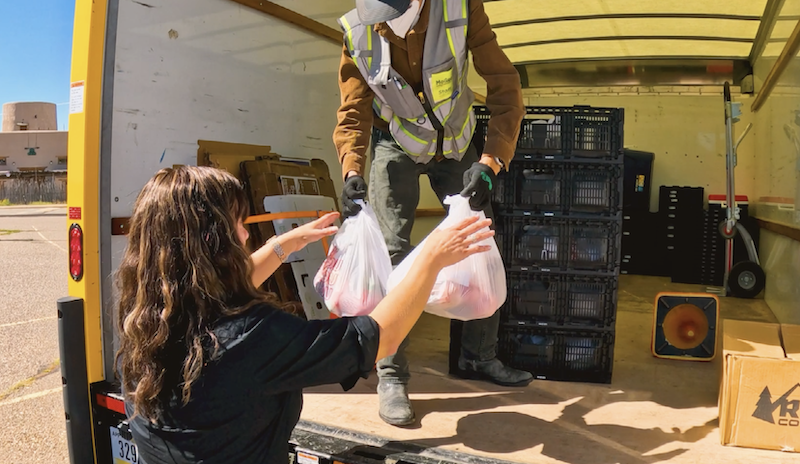 Increased and consistent sales opportunities can offer market stability, which then helps producers invest in and expand their operations.
“(what’s special about the hub is) the ability to help provide stable markets for farmers and ranchers in those areas that then gives them the confidence to be able to expand and grow their operations.” - H2
“And we can kind of discuss like helping farmers feel secure in the partnership so that they can expand their operations if they want to. So that's kind of that market stability piece. We're in conversation with them, trying to figure out how to make, create more stability for them to continue to farm the way they want to.” - H1
“A program like (produce) prescription programs allow us to have that avenue where we can plan our year-round operation, so that's been really beneficial to have that opportunity.” - F2
“I think the biggest benefit is to know that our farmers are more secure... That they’re able to grow, expand, and have confidence that what they are growing is gonna sell, and they’re gonna be able to invest more into their farm.” - H2
It was noted that there are many communities in need that have not been reached by FreshRx or similar types of programs, even though the local food system extends across many parts of the state and supply chain actors recognize the importance of serving people in remote communities. As a result, transportation and geography were cited as the most common challenges.
“The challenge is, obviously, New Mexico is a very big state, so the geographic coverage of the rural communities that we’re working with, that’s the challenge.” - H4
“ There’s places that aren’t being serviced. There’s distributions that aren’t happening all throughout our state. And even within, you know, the southern part of the state, especially, there’s a lot of missed areas, and so we have the opportunity to do more... Being able to expand that not just for our farmers but also helps with the distribution piece, and people being able to move more food up and down with their partners as well.” - H2
Hub representatives also noted that they are reaching the ceiling of what they can provide with the current resources and capacities they have available, especially related to distribution infrastructure. Yet the need remains immense in terms of populations and geographic areas that aren’t being reached by programs like FreshRx.
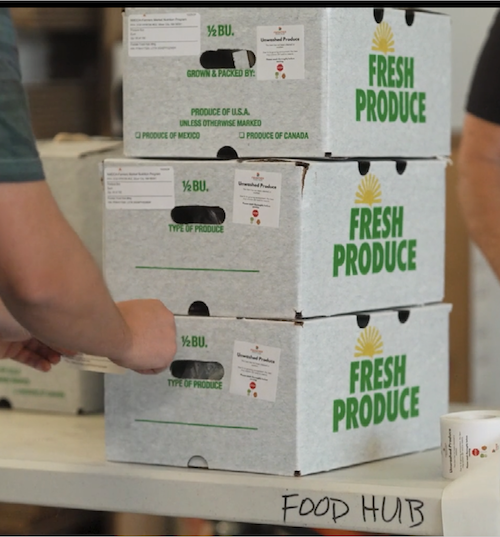 “We would like to be able to offer more like delivery support and go more places, and be able to kind of expand our operations a little bit... We are kind of hitting our limits, in like our ceiling in all of our operations. But there’s no shortage of need here, so we definitely want to continue to expand and, as much as we can, continue to serve our partners.” - H1
The challenge of capacity in rural/ more remote communities was also mentioned:
“What you do find is that maybe they (the community) don't have capacity as a team to be able to manage the distribution, or somebody there to be able to manage the communication, so then, you know, there's a missed opportunity that happens with that, or maybe they don't have infrastructure, they don't have a bigger cold storage, a freezer or a refrigerator... So there's a lot of stuff that plays a factor into the operational, but just trying to make it work.” - H4
Finally, uncertainty around program funding and planning was noted as a significant challenge.
“I guess, initially, (the biggest challenge) would be the uncertainty of if the program is going to exist the following year, or the next year, or in upcoming years, so that uncertainty has been problematic. Or, you know, it's there. So that's a little bit of a challenge. How do we assure that we can keep this program going, or something similar to it, and that we're not gonna leave the recipients hanging next year, or that type of thing.” - F2
“It (funding) seems like it's unknown every year... To be able to have at least an answer sometime the week, or within the year leading up to January. I feel like that just aligns with the producer's growing season... so if they knew that, hey, FreshRx is starting again, and you know, they know the actual, you now, quantity and the volume that is needed from them, they know how much seed to purchase, they know what to grow, they know how much their harvest should be... So that way there's a little bit more structure involved with it... The timeline of it is sometimes tricky.” - H4
Supplier interviewees also spoke of what could be:
“We’re utilizing the land... There's that saying where if you take care of the land, it'll take care of you. And so, if we believe in that mantra, then, you know by growing from it, we can make our communities healthier... And so, like I said, it’s another simple equation, you know? And we have it right here... It's so simple, and it's just up to us to actually just take action... You can't do anything by just thinking it, you have to actually do something, do it. We have an opportunity and it can, something big can grow from it." - F2
“What could we do to be able to expand it and be able to be more consistent with providing these types of food to the tables of these patients? So that way there’s opportunity for bigger impact within their own health, to be able to, you know, consume these types of foods and be able to see, you know, an impact, whether that’s physical, emotional, mentally... One of the biggest impacts... that people believe in and see the bigger picture of why we’re doing this work, and understanding who is the recipient of these bags, and seeing what types of impacts it could have... if we’d be able to expand or be able to increase the duration of the produce bags and the distribution.” - H4
“There's not a food hub in the state that isn't heavily subsidized at this stage. You know, there isn't a business model that exists for a food hub to operate as a standalone entity without that financial support. So, it's one, you know, trying to figure out a model that works that would minimize that support, knowing that federal funds are harder to come by right now, and or, two, trying to work with private funders in a way that coalesces a long-term vision for success for a food hub to be able to participate in food systems work and or something like the healthy food access program that is FreshRx.” - H3
“The more programs there are that are focused on sourcing local, the more we can buy from our farmers, which means the more stable their income is.” - H1
“Everyone that works in this area in New Mexico, at least I've known is, everyone's so resourceful and makes it happen somehow... I think about that a lot, you know, with the mentality of work in local food, is like you work with what you have, and get the van down, a little further down the road.” - H2