Giving New Mexico farmers, producers, and local food retailers the tools to GROW.
Española, New Mexico was established in Northern New Mexico in 1598 and was originally part of the Ohkay Owingeh pueblo village located at the confluence of the Rio Grande and the Rio Chama. Juan de Oñate and the Spanish settlers with him renamed the area to San Juan de los Caballeros, establishing the first Spanish capital in New Mexico ( City of Española, 2025 ) . This settlement was later moved to the village of Yunque off of the west bank of the Rio Grande and renamed San Gabriel. San Gabriel served as the official capital of New Mexico from 1609-1610, until the Villa of Santa Fe was established as the official capital of the Spanish government.
Today, Española has a population of around 10,000 people and ranks 7th in New Mexico for poverty with 1 in 5 residents living in poverty (Stacker, 2022; World Population Review, 2023). Because of its location between the communities of Santa Fe and Taos, and its close proximity to Los Alamos and the Los Alamos National Laboratory, one of New Mexico’s largest employers, Española sees a great deal of trade and pass through traffic. Its location between these larger communities has also fueled its position as a key drug trafficking community, with the highest per capita heroin overdoses in New Mexico (Garcia, 2006 ; National Drug Intelligence Center, 2002).
Because of its complex combination of rurality, poverty, and social determinants of health, community health centers shoulder much of the responsibility for connecting people with assistance resources such as healthcare and food. Established in 1972, El Centro Family Health (ECFH) has supported Northern New Mexico with 28 clinic sites throughout the region, and four clinic locations in Espanola : the Rio Arriba Health Commons, the Bond Street Clinic, the Coyote Clinic, and the Truchas Clinic (ECFH, 2025 ). For this study, the NMFMA partnered with the Rio Arriba Health Commons Clinic to run the FreshRx program in June and July, 2025.
The NMFMA and its FreshRx Program have partnered with ECFH for more than 10 year s, with El Centro first hosting the program as a pilot project before federal USDA GusNIP funding was secured to launch the statewide initiative. FreshRx typically serves 30 El Centro patients from Las Vegas, Española and Embudo for up to 16 weeks during the growing season. Initially, the program was run using vouchers for patients to redeem at local farmers’ markets. Because redemption rates were low (at around 60%), and because some El Centro communities reported that patients felt a cultural disconnect to their local farmers’ markets, El Centro and the NMFMA decided to pivot to a produce bag model, whereby produce bags are dropped off at participating clinics weekly during the growing season. For the purposes of this project, we combined the 2 models with patients receiving a limited number of vouchers as well as bags delivered to the clinics. In terms of the process, each week the clinic received a bag drop off of locally grown fresh produce on Thursdays around 1pm. Patients were instructed to come the same day to pick up the produce since the clinic does not have refrigeration or storage space for all of the food bags.
For FreshRx patients at the clinic in Española, the food provided in the CSA-style produce bags was sourced from a Tribally-owned and operated small-scale diversified farming operation located in central New Mexico, about 30 miles northeast of Albuquerque and 60 miles southwest of Española. To meet FreshRx demand in 2025, the farm aggregated fruits and vegetables from its own operation as well as three others: one farm in the South Valley of Albuquerque, one farm in El Guique (10 miles north of Española), and an orchard in Velarde (about 15 miles north of El Guique). Produce was aggregated, stored in cold storage, sorted, rinsed/washed (if needed), and packed into the produce bags at a food hub in Albuquerque. The farms in the South Valley and El Guique delivered their produce straight to the hub, while the aggregator farm picked up fruit from the orchard and delivered it to the hub along with their own produce. Delivery of the produce bags from the hub in Albuquerque to the Española clinic was handled by a second hub that has a northern New Mexico delivery route. FreshRx patients in the Española clinic service area can live up to 25 miles away, and they pick up their bags directly from the clinic. The aggregator farmer and representatives from both food hubs involved in this supply chain were interviewed for this research project.
The short local food supply chain for the Española produce boxes is represented by the following schematic and map below. All map locations are approximate, i.e., none are exact.

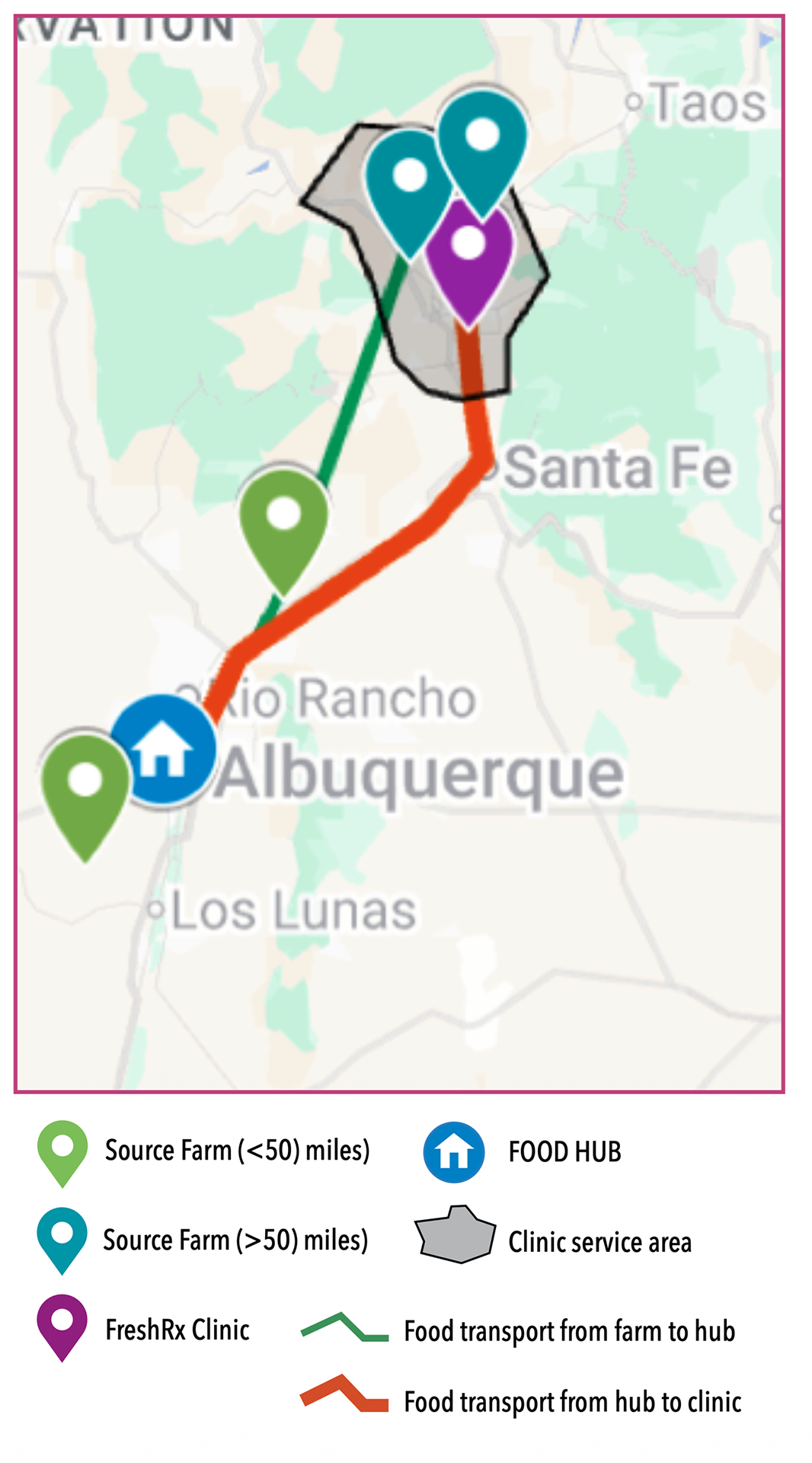 As the legend for the map indicates, the light green-colored source farms are those located within 50 miles of the food hub, and the turquoise-colored source farms are located more than 50 miles from the hub. Green lines show food transport from source farms to the hub, and the orange line shows transport of produce bags from the hub to the clinic. While the supply chain for the Española produce bags represents a local, short food supply chain, looking at the map reveals a gap in adequate aggregation and cold storage infrastructure in northern NM. Finally, the area in gray shows the approximate patient service area for the Española clinic.
Two program patients participated in the study. One participant was referred to the FreshRx program to assist with maternal nutrition, and another participant was referred to the FreshRx program based on prior participation. Both participants received the FreshRx food bags earlier in the season, and vouchers to the farmers’ market later in the season.
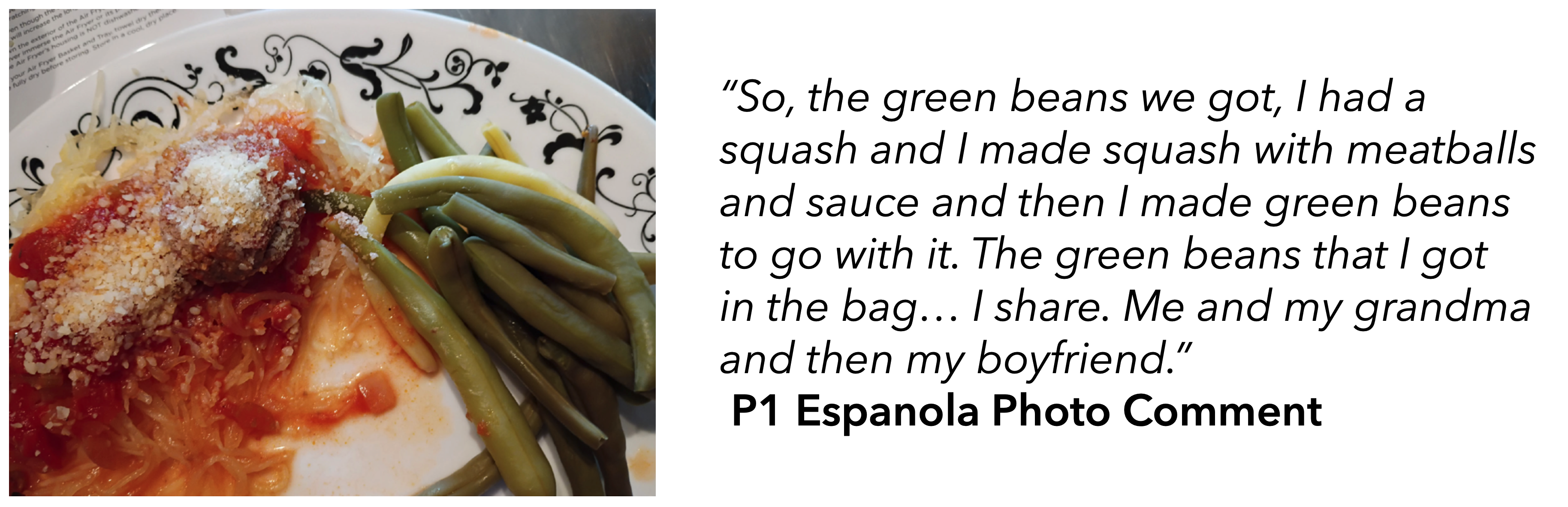
Both participants stated they enjoyed the food that was in the bag, and they were able to incorporate most of the provided items into their usual meal preparations. One participant cooks for her grandmother and boyfriend, and the other participant shares her food with family or neighbors who live in her housing complex. In this section with quotes from the participant interviews, P1 and P2 are the Española participants, and D is the research team member.
“D: So it sounds like you also give a lot of the food to your family. Are you the person in your family that does all this and then helps everybody?
P2: Yeah. Finally, they snapped that... I'm the only one that goes [to source food from food banks and food programs like FreshRx]. ” -P2 Española
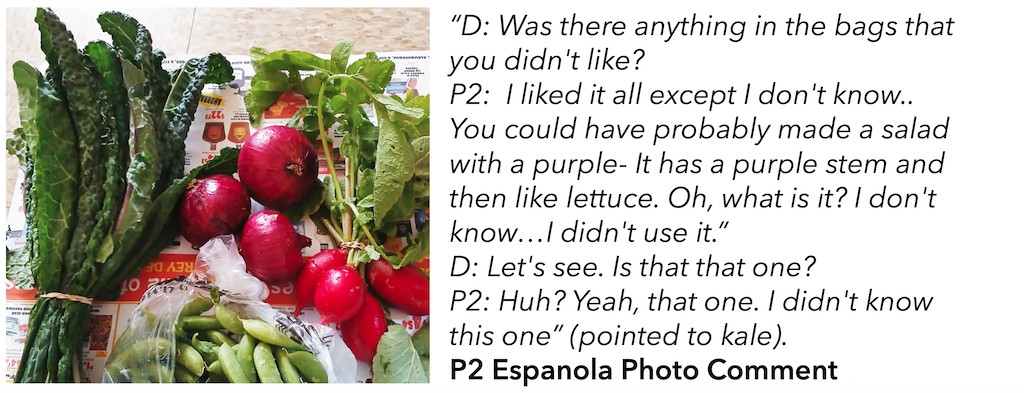
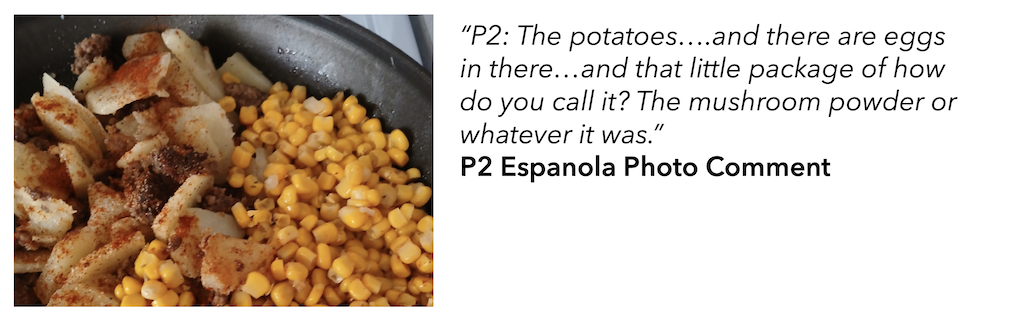
Some food items, such as kale, rhubarb, oyster mushrooms, and powdered mushrooms, were unfamiliar to one of the participants. She was able to incorporate the mushrooms, but gave the kale to her sister. Peas were her favorite food item from the FreshRx bags.
 When asked about barriers to picking up the bags, Participant 1 shared that it was sometimes difficult for her to get a ride to the clinic to pick up the produce bags.
“The only thing that's hard is having to go to get the food because sometimes I won't have a ride.” - P1 Española
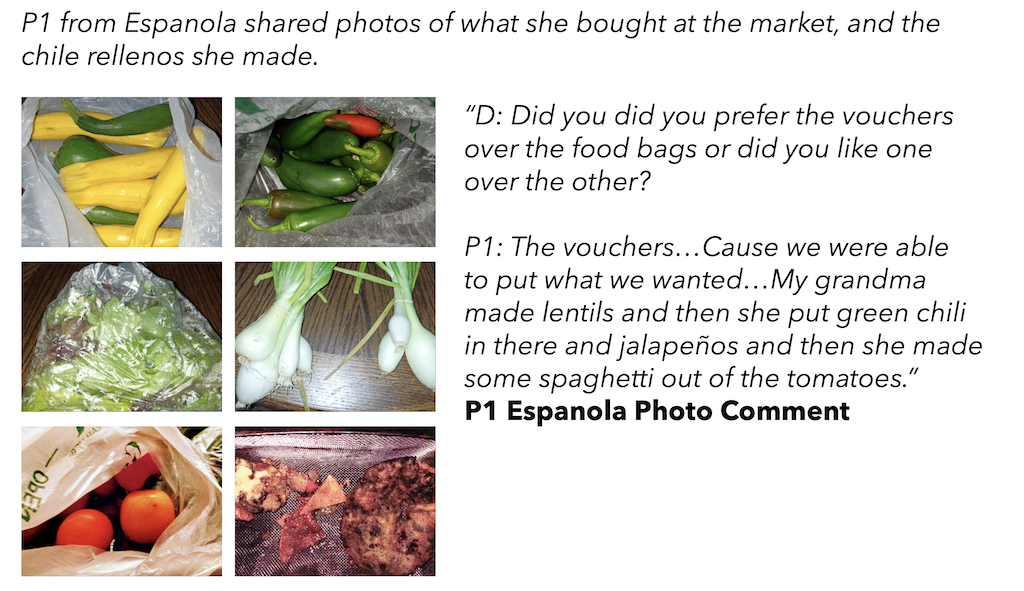
Both participants preferred the farmers’ market vouchers over the produce bags, but with different reasons. Participant 1 shared that she liked being able to pick the things she wanted, and Participant 2 stated she preferred going to the market because it was more fun.
“D: What did you think was different between getting the bags here and going to the market?
P2 Española: More fun over there. It's more fun. And for our people.” -P2 Española
Participant 2 shared that the vouchers were able to cover everything she bought at the market, but the cost of items at the market were shocking for her.
“ It's expensive at the farmers’ market. I can't believe I'm looking at the pinon. $35 for a tiny bag.” - P2 Española
When asked what they wish policymakers, farmers, and program administrators knew about the program, Participant 1 shared the program was good and they had no feedback. Participant 2 shared that they wish policymakers would help to bring food prices down and would “get into the fields themselves.” Participant 2 also shared that handing out the produce bags at a booth at the market would be an improvement, since it is closer to town than the clinic.
“They need to go out in the field themselves... What's happening? It's breaking us... You go for creamer, you go $7 for the creamer and the coffee. Then every time you go $3 more up. Little can of coffee, $24. What the hell are they doing to us?” - P2 Española
“D: So if you could tell the farmers anything, you'd tell them that they did a good job?
P2: Yeah. And I feel sorry for them. It's a lot of work.”- P2 Española
“D: And then what do you think that they could do to make the program better? Is there anything you think that they could do to improve?
P2: Meet at the farmers’ market. Meet them at the farmer's driving way up here. Be there on Mondays, like, in a separate little table or something like that... It's closer because it's way up here, and then if you're dealing with farmers’ market, nice to be around with the harvest.” - P2 Española
More photos from the Española participant group can be found in Appendix B.